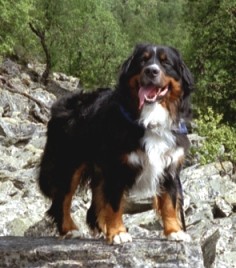
Click on the picture and you are
brought to the Berner University
with wonderful illustrations of standard Berner Sennen
Flott berner gutt - Kendo til Hilde Berntsen
Origin:
Switzerland
Date of Publication of the valid Original Standard:
March 12, 1993 --------------------------------------------------UPDATED
VERSION
Utilization:
Originally used as a guard and draught dog and for driving cattle
in the Kanton Bern; today also multi purpose, companion and family dog
FCI-Classification:
Group 2 (Pinscher and Schnauzer type - Molossian type and Swiss Mountain
and Cattle Dogs)
Section 3 (Swiss Mountain and Cattle Dogs)
Without working trial
Brief historical summary
The Bernese Mountain Dog is a farm dog of ancestral origin which was
used as a guard and draught dog and for driving cattle in the prealpine regions
and in the midland areas around Bern. Originally he was named "Dürrbächler"
according to the name of the hamlet and of the inn of Dürrbach, near Riggisberg,
where this longhaired tricoloured farm dog was especially appreciated
In 1902, 1904 and 1907 subjects of this breed were exhibited at dog shows. In
1907 a few breeders of the region of Burgdorf decided to promote the pure breeding
of this native dog by founding the "Schweizerische Dürrbach-Klub"
and fixing the characteristic traits of the breed in a first standard. In 1910,
at the invitation of the "Dürrbach-Klub", there were already 107 subjects
shown by the farmers at this very special event.
From that day onward this dog, renamed "Bernese Mountain Dog" (following
the example of other breeds of Swiss Mountain Dogs) became rapidly known all
over Switzerland and Southern Germany. Today the Bernese Mountain Dog is well
known and appreciated all over the world as a companion and family dog thanks
to its striking tricoloured coat and its great adaptability.
General appearance
Longhaired tricoloured working dog, of above medium size, sturdily
built, yet agile; well balanced in all parts
Important proportions:
Height at withers : length of body = 9 : 10
compact rather than long
Behavior - Temperament:
Self confident, attentive, vigilant, fearless in situations of every
day life, good natured and devoted to his own people, self-assured and friendly
towards strangers; of average and docile temperament
Head:
strong; skull viewed from front and in profile very slightly rounded;
facial-cranial depression (stop) well defined without being too pronounced;
frontal furrow slightly marked
Nose: black
Muzzle: strong, of medium length; nasal bridge straight
Lips: not much developed; well fitting to the jaws; with black pigmentation
Mouth: strong, complete dentition, scissor bite
Eyes: dark brown, almond shaped, with well fitting eyelids
Ears: triangular shape, slightly rounded at the tip, set high, medium
sized, in repose hanging flat and close to the head
Neck:
strong, muscular, of medium length
Body:
compact and sturdy
Back: firm, straight and level
Loins: broad and strong
Rump: slightly rounded
Chest: broad and deep, reaching to the elbows; forechest well developed;
chest and ribcage of wide-oval cross-section
Belly: not tucked up
Tail: bushy, reaching at least to the hocks; hanging straight down when
at rest; carried level with back or slightly above when moving
Limbs
Forequarters:
Rather wide apart, straight and parallel
Shoulders: shoulder-blades long, strong and well laid back, forming a not too open angle with the upper arm, well attached to the chest, well muscled
Pasterns: almost vertical (or very slightly oblique), firm
Feet: short, round and tightly bunched; well arched toesHindquarters:
Seen from the rear straight and not too narrow; hocks and feet neither turning in nor out; dewclaws must be removed
Thighs: rather long, strong, broad and well muscled, with well bent stifles
Hocks: strong, well angulated
Gait/Movement
Sound and balanced movement in all gaits covering a lot of ground;
free stride reaching well out in front, with plenty of drive from behind; at
the trot coming and going, legs moving forward straight and parallel
Hair:
Long, smooth or slightly wavyColor:
Jet black with rich tan markings on cheeks, over the eyes, on all four legs and on the chest, and with white markings as follows:
- clean white symmetrical markings on the head: blaze extending towards the nose on both sides to a muzzle band; the blaze should not reach the tan markings above the eyes, and the white muzzle band should not extend beyond the corners of the mouth
- moderately large, unbroken white markings on throat and chest
- desirable: white feet, white tip of tail
- tolerated: small white patch on nape of neck, small white anal patch
Size
Males 64 - 70 cm at withers, ideal size 66 - 68 cm
Females: 58 - 66 cm at withers, ideal size 60 - 63 cm
Faults
Any departure from the foregoing points should be considered a fault
which should be penalized in proportion to its seriousness and importance
Disqualifying faults:
N.B. Males should have two apparently normally developed testicles fully descended into the scrotum.